



Anxiety Lives in the Body First
We tend to talk about anxiety as if it were a thought: I am worried about work, about money, about the kids. But if you check in with your body when it is at its worst, you will find a heart going faster than it needs to, a chest that feels tight, shoulders up around your ears, a stomach that will not settle, and breathing that has gone shallow and high without you noticing.
That is the stress response doing exactly what it evolved to do: getting you ready to fight or run. The trouble is that the thing you are anxious about is rarely something you can fight or run from, so the body stays revved with nowhere to put it. And once the body is revved, the mind follows. Racing thoughts are often the passenger, not the driver.
Why You Cannot Think Your Way Out
The part of the nervous system that runs the stress response does not take instructions from the thinking brain. You can tell yourself to calm down for an hour and your heart rate will not care. What it does respond to is the breath, because the breath is the one part of the stress response that sits under both automatic and voluntary control. You breathe without thinking, and you can also choose how to breathe. That makes it a lever.
Slow the out breath down and lengthen it, and the calming side of the nervous system switches on. Heart rate follows. Muscles follow. Then, and only then, the mind begins to quieten, because the body has stopped sending it emergency messages.
The part of you that is anxious is not listening to words. It is listening to your breath.
Liane
What a Breathwork Session Does With That
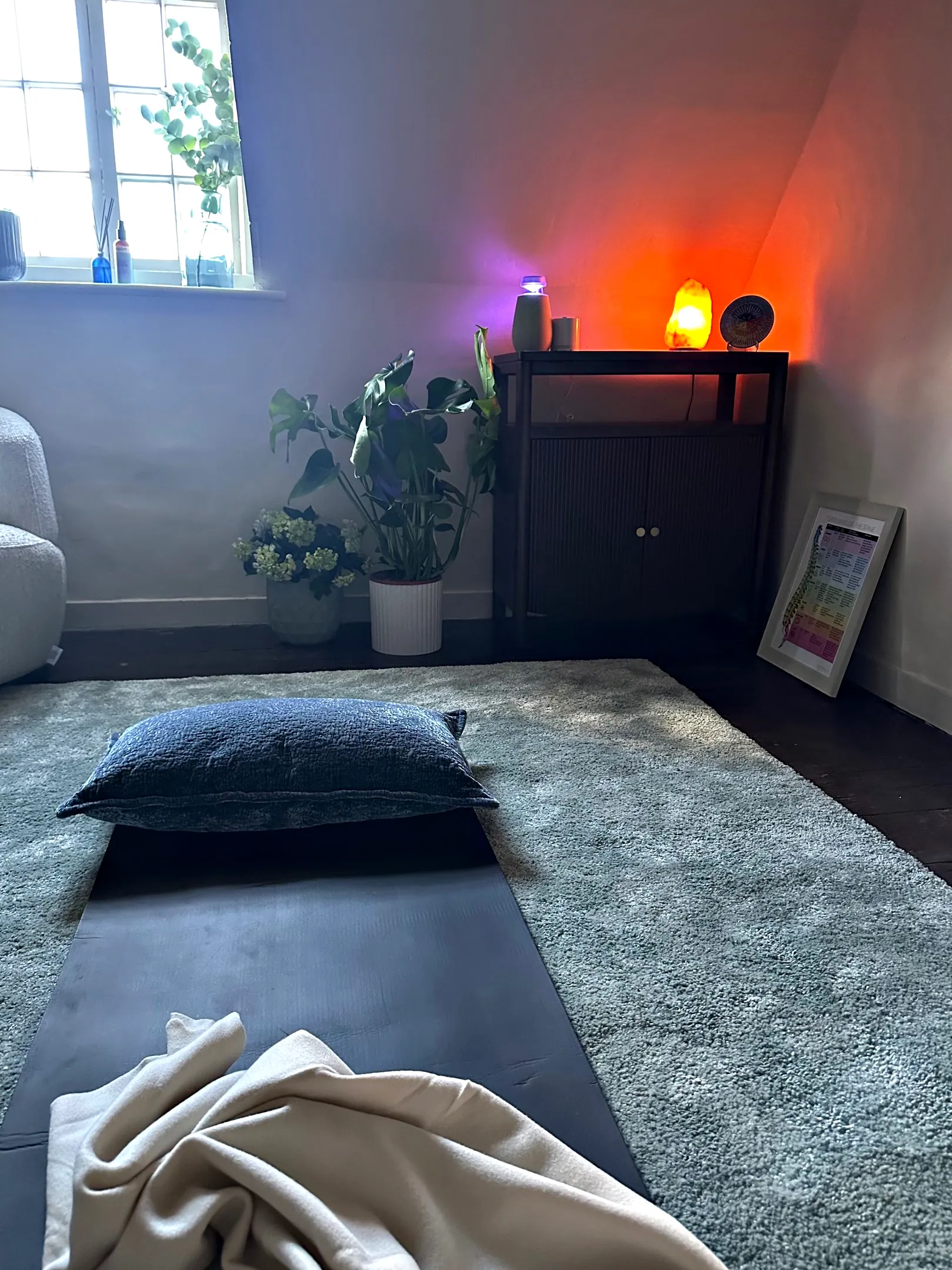
A conscious connected breathwork session takes that lever and pulls it hard, for a good stretch of the session, lying down in a dim room with music. The first ten minutes are the mind fighting to stay in control, and then the surrender comes and the body takes over. What people tell me afterwards is that the low hum of dread they had lived with for months has turned down, that they slept properly for the first time in ages, and that they are less reactive with the people they love.
Vanessa put it better than I can: "I've been full of energy, incredibly calm, and way less stressed about life and work. It's like a big, black cloud has floated away."
I should say clearly: none of this is a treatment for an anxiety disorder, and it is not a replacement for your GP, for counselling or for medication. Many of the people who come to me do those things too. If you have panic attacks, or a history of psychosis, or you are struggling to cope day to day, talk to your doctor first and tell me when you book. And if you are in crisis right now, call NHS 111, or Samaritans on 116 123.
Group Evening, One to One, or the Tremor
For most people a group evening is the gentlest way in. You are one of a room, nobody is watching, and the energy of twenty people breathing together carries you through the hard first ten minutes. If a room feels like too much, or if your anxiety has a particular root you want to work on, a one to one at the studio in Olney is two hours shaped around you, with a proper chat first.
And if your anxiety lives mostly in the body, in a jaw you clench and shoulders that never come down, tremor therapy is worth knowing about. A few gentle exercises, then the body shakes off what it is holding, on its own, with you in control. People who have never managed to relax in a relaxation class often find this is the one that works.
One Thing to Try Tonight
You do not need a session to start. Try this in bed, lights off. Breathe in through the nose for a count of four. Hold for seven. Breathe out through the mouth, slowly, for a count of eight, as if you were breathing out through a straw. Do it four times. The long out breath is the part that matters: it is the signal the body is waiting for. The breathing tool on this page will count it for you.
If your mind wanders, that is fine. Come back to the count. If four rounds becomes eight, better. If you fall asleep in the middle, best of all.
Three Signs Your Anxiety Is in the Body
- Your shoulders are up and your jaw is tight, and you only notice when someone points it out.
- You sigh a lot, or catch yourself holding your breath.
- You feel wired at night and exhausted in the morning.
If any of that sounds familiar, there are three ways in: a group breathwork evening, a one to one session, or tremor therapy for the tension that lives in the body. The help with anxiety page explains which fits which, and I am always happy to point you to the right one on WhatsApp.